In the race for digital transformation, the finish line keeps moving. First, it was about basic virtualization; now, it is about AI-driven velocity and massive data scaling. Despite heavy investments in cloud computing and storage, many enterprise migrations are hitting a wall.
The problem usually isn’t your application code or the choice of cloud provider. The bottleneck is often closer to home: the network. Traditional network infrastructure creates “network debt” that silently kills cloud agility. To benefit from the cloud, enterprises must reset their strategy. The answer lies in open networking, specifically, the power of SONiC and disaggregation.
In this article, you’ll discover how proprietary networking quietly stalls your cloud strategy and why open-source solutions can finally unlock the speed, scale, and freedom your business needs.
The Network Debt You Didn’t Know You Had
There’s a liability on your balance sheet you can’t see, but it’s costing you dearly: network debt.
Remember standardizing on a single networking vendor five or ten years ago? At the time, it was logical: one throat to choke, consistent hardware, predictable support. Your network team developed deep expertise on a single platform.
What that decision really did was mortgage your organization’s future flexibility to a vendor roadmap you don’t control. Today that choice shows up as an “invisible growth barrier” in three painful ways:
1. Your Innovation Speed Is Vendor-Locked
When your proprietary vendor chooses which features to develop, you wait. When they decide to end a product line, you scramble. When the business demands AI-scale support, you file a feature request and hope it lands in the next roadmap.

Meanwhile, other market players that have embraced open networking are already provisioning AI training clusters, feeding models with data at scale, and iterating infrastructure changes in hours instead of months.
AI and machine learning move at blistering speed, and infrastructure velocity is now a competitive imperative. If your network can’t keep pace, you’re not merely behind: you fall further behind every quarter.
2. Your TCO Hides Time Bombs
Research shows up to 63% of network misconfigurations stem from license-feature mismatches. One hospital chain saved on initial CAPEX by going with a minimalist licensing tier, only to face 19% higher TCO over three years due to upgrade labor costs when their functional requirements inevitably expanded.
Patch management multiplies the pain. Each security update often requires coordinated vendor procedures that delay critical fixes and extend application downtime.
3. Your Cloud Architecture and On-Prem Network Speak Different Languages
“Lift and shift” misfires because on-prem proprietary networking and cloud infrastructure are philosophically and operationally different.
Proprietary switches typically bundle control plane (decision logic) and data plane (packet forwarding) into monolithic devices, managed via CLI one device at a time. They resist automation and can’t be version-controlled like application code.

Cloud infrastructure, by contrast, is disaggregated, API-driven, and built around infrastructure-as-code. It’s ephemeral, scalable, and fully automatable. Trying to bridge those two architectures without changing the on-prem network is like trying to run a cloud-native app on a legacy OS – you can plan all you want, but the mismatch is structural.
If these are the problems holding you back, the answer is an architectural reset. Hyperscalers showed how this reset works in practice.
The Open Networking Shift: How Hyperscalers Solved This Problem
When Microsoft, Google, and Meta built planet-scale cloud networks, they didn’t simply buy bigger proprietary boxes. They rethought networking at the architecture level and open-sourced the results.
Thus, the hyperscalers’ approach rests on three transformative principles:
Principle 1: Disaggregation via SAI
The Switch Abstraction Interface (SAI) is the quiet enabler of modern open networking. It’s a standardized API that separates the network operating system from the silicon underneath. Think of SAI like what Linux did for computing: it freed organizations from vendor lock-in. SAI ends the decades-long pattern of bundling hardware and software together in networking.
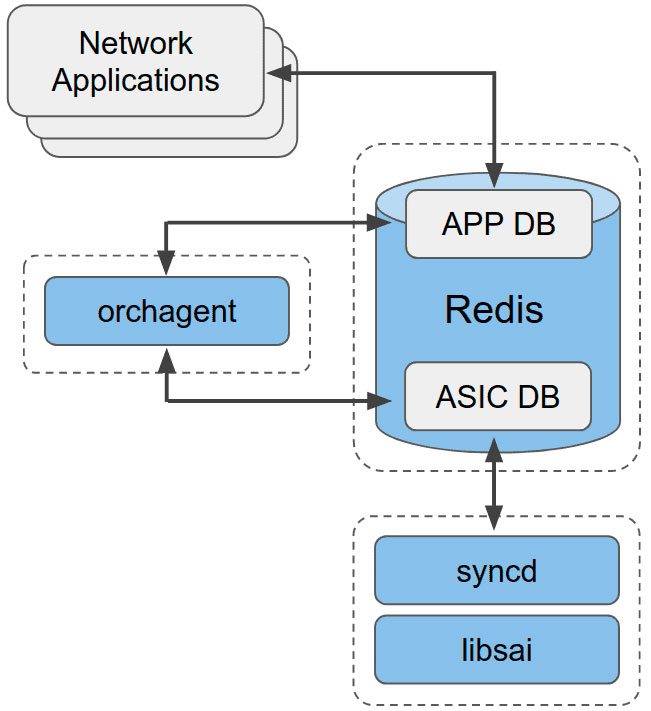
SAI from SONiC perspective
With SAI, you can:
- Choose the best hardware from multiple vendors.
- Take advantage of rapid innovation in switch silicon, port speeds, and density.
- Preserve software investments across hardware refresh cycles.
- Swap underperforming hardware without changing your network configuration.
It’s true, multi-dimensional freedom.
Principle 2: Cloud-Native Architecture with SONiC
SONiC (Software for Open Networking in the Cloud) is a Linux-based network operating system hardened in the production fleets of the world’s largest cloud providers. We’re talking billions of packets per second, 24/7 uptime expectations.
SONiC’s microservices design is key. Network functions run in isolated Docker containers, with a centralized Redis database for configuration and state. If one service fails, it fails without bringing down the whole NOS.
This mirrors public cloud patterns: resilience, isolated failures, and automation. SONiC is also continuously validated through automated testing and benefits from a global community of contributors.
Download our white paper to learn more about SONiC's capabilities and unlock its potential for your business. Discover how SONiC can revolutionize your network infrastructure, offering unparalleled flexibility, scalability, and cost optimization.
Principle 3: API-Driven Programmability
Software-Defined Networking (SDN) decouples control logic from physical devices. Instead of configuring switches one CLI at a time, a centralized controller manages topology with a global view. That changes everything: your network becomes programmable through APIs. Configuration becomes code. Changes can be version-controlled, tested, and deployed via your existing CI/CD pipelines.
Taken together, disaggregation, a cloud-native NOS, and API-first programmability don’t just improve operations – they change your entire cost structure.
The TCO Transformation: Where Your Money Actually Goes
If open-source software is free, what’s the catch? The catch is a shift in the cost model which moves expense from static vendor fees into flexible investments.
With proprietary networking you typically pay for:
- Premium, vendor-marked hardware (HWc).
- Perpetual, recurring software licenses (SWc).
- Mandatory support contracts regardless of usage (Sc).
- Limited customization inside vendor boundaries.
- Features delivered on the vendor’s timeline.
With open-source networking you invest in:
- Commodity or white-box hardware at market rates (reduced HWc).
- Zero licensing fees (eliminated SWc).
- Targeted support from specialists who know your environment (optimized Sc).
- Building internal capabilities and specialist expertise.
- Custom features developed when and how you need them.
Lower licensing and commodity hardware are powerful, but they create a new reality: free software still needs skilled people and smart partners.
Considering a switch to open-source networking?
Explore the reasons to choose an open-source NOS like SONiC, along with a breakdown of the Total Cost of Ownership (TCO) for both proprietary and open-source solutions.
The Open Source Paradox: Free Software Needs Expert Partners
Let’s be frank: SONiC being free to download doesn’t mean it’s a plug-and-play magic wand.
Open-source adoption is widespread – about 95% of organizations in the poll have increased or maintained their use of open-source software in the past year – but the ones scaling successfully don’t go it alone. They partner with domain experts who convert perceived open-source risk into differentiated capability.
This is where PLVision’s decade of experience in open, disaggregated networking matters. We’re engineers who contribute to the SONiC Community, hold governance roles, and have driven demanding network transformations.
PLVision builds production-ready, hardened Community SONiC images for data centers, solving common deployment pain points. Our images:
- Eliminate vendor lock-in.
- Ensure compatibility with white-box hardware.
- Remove the complexity of juggling multiple vendor NOS versions.
- Undergo rigorous testing for seamless integration.
- Simplify rollouts and reduce operational risk.
- Provide control over updates and custom features, allowing you to implement changes on your own schedule and avoid unwanted or disruptive modifications.

For organizations needing more flexibility, PLVision offers custom SONiC distributions tailored to specific use cases. SONiC’s flexibility does demand in-house expertise for customization and maintenance — but a bespoke distribution delivers cost efficiency, vendor neutrality, and freedom from subscription fees. Our custom builds support high-speed switching (100G/400G/800G), advanced protocols (BGP, VXLAN, EVPN), and multivendor integration, giving you full ownership and agile scale.
Telecom operators can also adopt SONiC with carrier-grade extensions: PLVision addresses community limitations by incorporating telco-grade features, accelerating development while aligning with sustainability, support, and budget requirements.
For DC, campus, and edge deployments, PLVision’s SONiC Lite streamlines enterprise features into a lightweight NOS optimized for management and access switches. By removing unnecessary modules, SONiC Lite runs efficiently on simpler hardware without compromising performance or reliability. Our solutions enable SONiC deployment across all network layers, giving you a unified, centralized control plane for your entire network.
Conclusion
Cloud migration delays are a business risk. Every month your workloads stay trapped behind proprietary networking, other businesses are building AI-enabled advantages you can’t match.
The path forward requires two decisive moves:
- Commit to open networking. Embrace disaggregation, adopt SONiC as your NOS foundation, and free your infrastructure from vendor lock-in.
- Partner with experts who’ve done this at scale.
Explore how PLVision’s open networking expertise can turn a stalled cloud migration into a strategic advantage. Our team can assess your environment, demonstrate what’s possible, and deliver the end-to-end transformation your business needs.
Your cloud is ready. Your applications are ready. Your team is ready. It’s time your network caught up.
Want to fast-track your cloud migration?