First in a two-part series on optical circuit switching in AI data centers – this article explains why Optical Circuit Switching (OCS) is becoming part of next-generation AI datacenter architectures. In Part 2, we’ll examine the software challenge behind that transition-and why programmable network operating systems such as SONiC, combined with custom control-plane development, are becoming essential building blocks rather than optional enhancements.
AI infrastructure is changing faster than traditional network architectures were designed to accommodate. As GPU clusters grow from thousands to tens of thousands of accelerators, the assumptions behind packet-switched Clos and fat-tree fabrics begin to break down. Scaling through larger ASICs, deeper buffers, and additional switching tiers increasingly comes at the cost of power, latency, and operational complexity.
Optical Circuit Switching (OCS) is emerging as one of the industry’s most promising responses. By establishing end-to-end optical paths rather than forwarding packets hop-by-hop through electronic switches, OCS reduces switching overhead, lowers power consumption, and enables new approaches to large-scale AI fabric design.
For teams evaluating optical circuit switching for AI data center builds, the appeal is straightforward on the surface – fewer hops, less power, lower latency. The harder question is what it takes to operate that fabric once it’s installed.
Why Optical Circuit Switching Becomes a Software Problem
OCS changes more than the physical network.
Unlike conventional Ethernet fabrics, where most intelligence resides inside switching silicon, OCS deliberately moves much of that intelligence into software. Deciding when to establish optical circuits, how to schedule them, how to synchronize routing, telemetry, and workload placement across a constantly changing topology becomes a distributed software engineering problem.
This architectural shift is why programmable networking platforms such as SONiC are becoming increasingly relevant. OCS hardware may create optical paths, but operating a production-scale optical fabric requires extensible control planes, orchestration systems, telemetry, and automation that go well beyond what current commercial networking stacks provide.
This first article focuses on why OCS is becoming unavoidable. The second explores what it takes to build and operate these programmable optical fabrics – and where custom software development becomes the critical differentiator.
Download our white paper to learn more about SONiC's capabilities and unlock its potential for your business. Discover how SONiC can revolutionize your network infrastructure, offering unparalleled flexibility, scalability, and cost optimization.
OCS Is a Circuit-Reservation System, Not a Switch – How Optical Circuit Switching Works
Understanding Optical Circuit Switching starts with recognizing what it does – and, just as importantly, what it does not do.
At the physical layer, an optical circuit switch connects an input fiber to an output fiber through a switching element such as MEMS mirrors, liquid-crystal devices, robotic fiber-patching systems, or silicon-photonic components. No packet inspection takes place. No forwarding decisions are made. The payload remains entirely in the optical domain, creating what is effectively a temporary piece of dedicated fiber between two endpoints.
That distinction is fundamental. An OCS device does not replace an Ethernet switch in the traditional sense; it replaces a physical path. It establishes a circuit, keeps that circuit active for a period of time, and later reassigns optical resources when traffic demands change. It is best understood as a circuit-reservation system rather than a packet-forwarding device.
This changes where complexity lives.
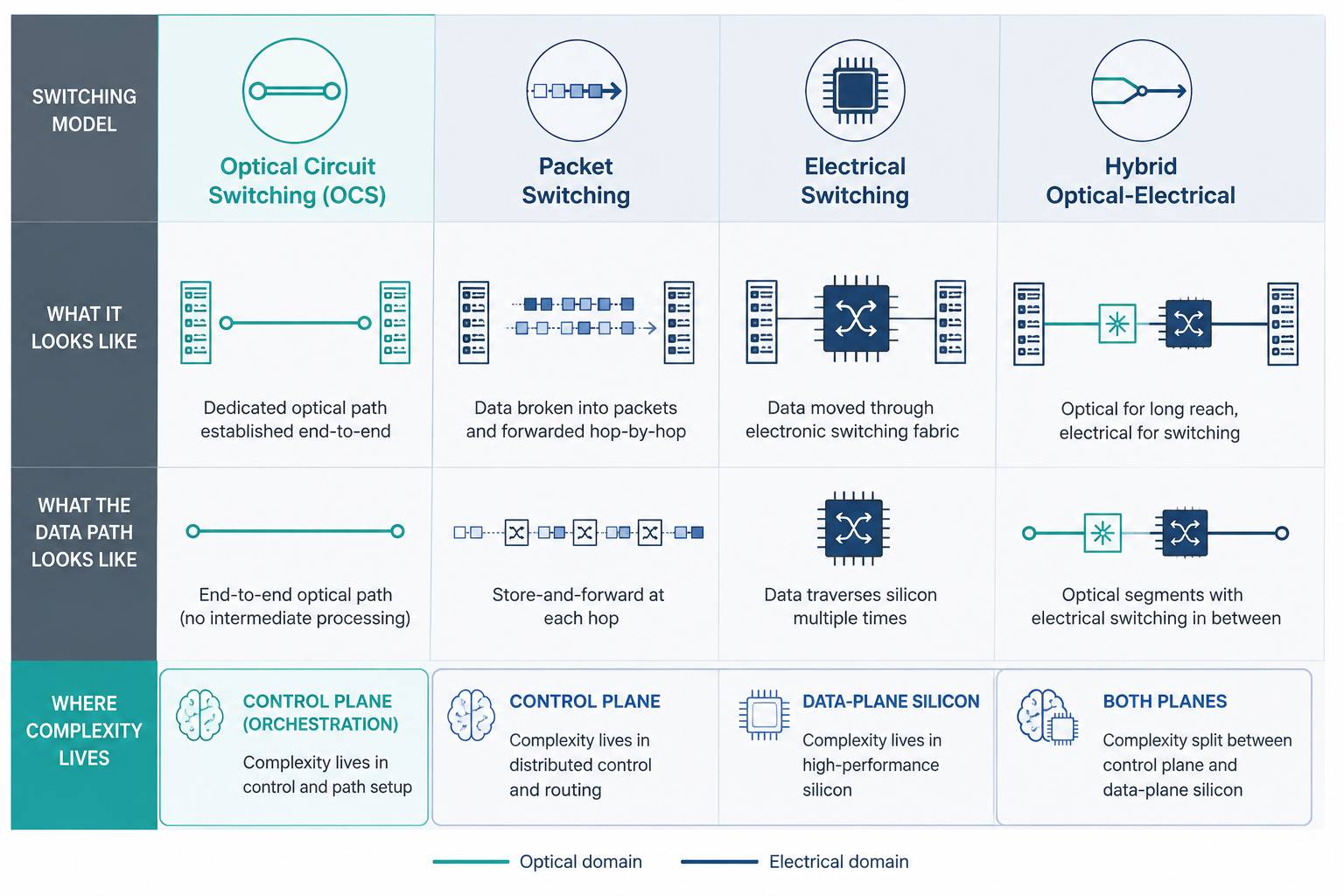
In packet-switched networks, forwarding decisions, congestion handling, buffering, and traffic distribution are implemented inside the switching fabric itself. OCS deliberately removes most of that functionality from the data plane. Once a circuit exists, forwarding becomes almost trivial. The difficult engineering questions move elsewhere:
- Which workloads should receive dedicated optical circuits?
- When should circuits be created or released?
- How should routing adapt to a changing physical topology?
- How are telemetry, inventory, transceivers, and network state kept synchronized?
- How do higher-level orchestration systems coordinate these changes without disrupting running workloads?
In other words, OCS simplifies packet forwarding by making network control significantly more sophisticated.
This is where the discussion begins to move beyond optics and into software architecture. Building an optical fabric is no longer simply a matter of deploying switching hardware. It requires a programmable control plane capable of orchestrating multiple systems, integrating with existing Ethernet infrastructure, and exposing automation interfaces for higher-level schedulers.
Technologies such as SONiC are increasingly interesting in this context – not because they provide native OCS management today, but because they offer an extensible networking platform that can be customized with new orchestration, telemetry, and control-plane capabilities. As optical networking becomes programmable, what sets one implementation apart increasingly comes down to the software architecture built on top of it, not the hardware spec sheet.
That shift – hardware-defined networks giving way to software-defined optical fabrics – is the thread that runs through the rest of this series.
Table 1 – Switching Models Compared
| Dimension | Optical Circuit Switching | Packet Switching | Electrical Switching | Hybrid Optical-Electrical |
|---|---|---|---|---|
| Forwarding model | Circuit reservation in the optical domain; path established end-to-end before payload flows | Per-packet forwarding with statistical multiplexing and buffering | Same as packet switching, implemented in electronic fabrics | Optical circuits for elephant flows, electrical fabric for bursty/latency-sensitive flows |
| Typical topology | Flatter, direct-connect, block-level reconfigurable | Clos / fat-tree / leaf-spine, multi-hop | Same as packet switching, bounded by ASIC radix and power | Multi-tier: optical core augments electrical edge |
| Forwarding latency | Near-zero once circuit exists | Higher – hop-by-hop processing and queuing | Similar to packet switching, dominated by queueing | Low for optical-plane flows, standard for electrical-plane flows |
| Reconfiguration cost | Critical design parameter: sub-ns device physics to μs-ms system-level retuning | None – per-packet scheduling only | None at circuit level | Requires coordinating optical reconfiguration with electrical fallback |
| Scaling limits | Port count, fiber management, control-plane complexity, traffic-matrix locality | Radix, power, cabling, congestion | Power and cost of large-radix ASICs, buffering | Orchestration complexity and optical inventory/cabling |
| Where the complexity lives | Almost entirely in the control plane | Distributed across data-plane silicon | Data-plane silicon | Split, but concentrated in cross-layer coordination |
Considering a switch to open-source networking?
Explore the reasons to choose an open-source NOS like SONiC, along with a breakdown of the Total Cost of Ownership (TCO) for both proprietary and open-source solutions.
Five Patterns Already Showing Up in Production Fabrics (Optical Circuit Switching Use Cases in AI Data Centers)
The industry is no longer experimenting with OCS in isolation. Production deployments are converging around several recurring architectural patterns, each solving a different scaling problem – but each also introducing a new layer of operational complexity.
Rather than viewing these patterns simply as network topologies, it is more useful to view them through a software lens. Every time an optical path becomes dynamic instead of static, control-plane software inherits new responsibilities.
Table 2 – OCS Application Patterns in AI Datacenters
| Pattern | Where it sits | What it replaces or adds | Primary benefit |
|---|---|---|---|
| Spine replacement | Between leaf and spine layers | Static packet-switched spine | Fewer switch/optical-module hops on the critical path; each hop removed saves roughly a microsecond of packet-switch latency plus ~100 ns of optical-module latency |
| Scale-up (intra-POD) | Inside a single compute pod | Fixed electrical fabric between accelerators | Very high bandwidth, latency-sensitive, job-specific connectivity that changes per training run |
| Scale-out (third layer) | Above the spine, connecting PODs | Traditional three-layer fat-tree | Smooth growth past ~10,000 accelerators without adding hash-collision-prone hops; reported hash-collision points drop from four to three when OCS replaces a spine tier |
| Backup pooling | Across superpods | Per-superpod dedicated standby hardware | Shared, dynamically-allocated backup capacity instead of one-for-one redundant nodes, because the circuit – not a fixed cable – defines the failover path |
| Physical DC slicing | Across the whole fabric | Manual, cable-level tenant isolation | Software-defined physical isolation between tenants, with the same hardware reconfigurable into a single large cluster or several isolated ones |
The common pattern is clear: OCS simplifies packet forwarding while significantly increasing the importance of orchestration software. As networks become physically reconfigurable, the operational intelligence lives in software rather than in hardware.
Hardware Is Maturing Faster Than Software
At first glance, the OCS market appears to be following the same trajectory Ethernet switching did two decades ago. Multiple vendors now offer production-ready optical switching platforms based on MEMS mirrors, silicon photonics, liquid-crystal devices, and robotic fiber switching. Port density is increasing, switching latency is decreasing, and power efficiency continues to improve. From a hardware perspective, the market is rapidly maturing.
The software ecosystem tells a different story.
Unlike Ethernet switching, OCS has yet to converge around common operational models. Vendors expose different APIs, telemetry models, provisioning workflows, and management semantics. The challenge is no longer the optics themselves-it is orchestrating heterogeneous infrastructure.
Modern AI datacenters combine Ethernet fabrics, optical switching, GPU schedulers, observability platforms, and automation systems. Every vendor-specific interface increases the complexity of integrating these components into a coherent operational model. As a result, competitive differentiation is gradually shifting from optical hardware toward the software that coordinates it.
This is one of the reasons the networking community is investing in open, extensible platforms such as SONiC. Rather than treating every optical platform as a separate management domain, SONiC provides a foundation for building vendor-neutral orchestration, unified telemetry, and consistent operational workflows that can evolve alongside the underlying hardware.
The transition mirrors what happened in Ethernet networking. As merchant silicon commoditized switching hardware, differentiation moved into the network operating system and automation software. Optical networking appears to be following the same path.
The Power Argument Is, If Anything, the Stronger One
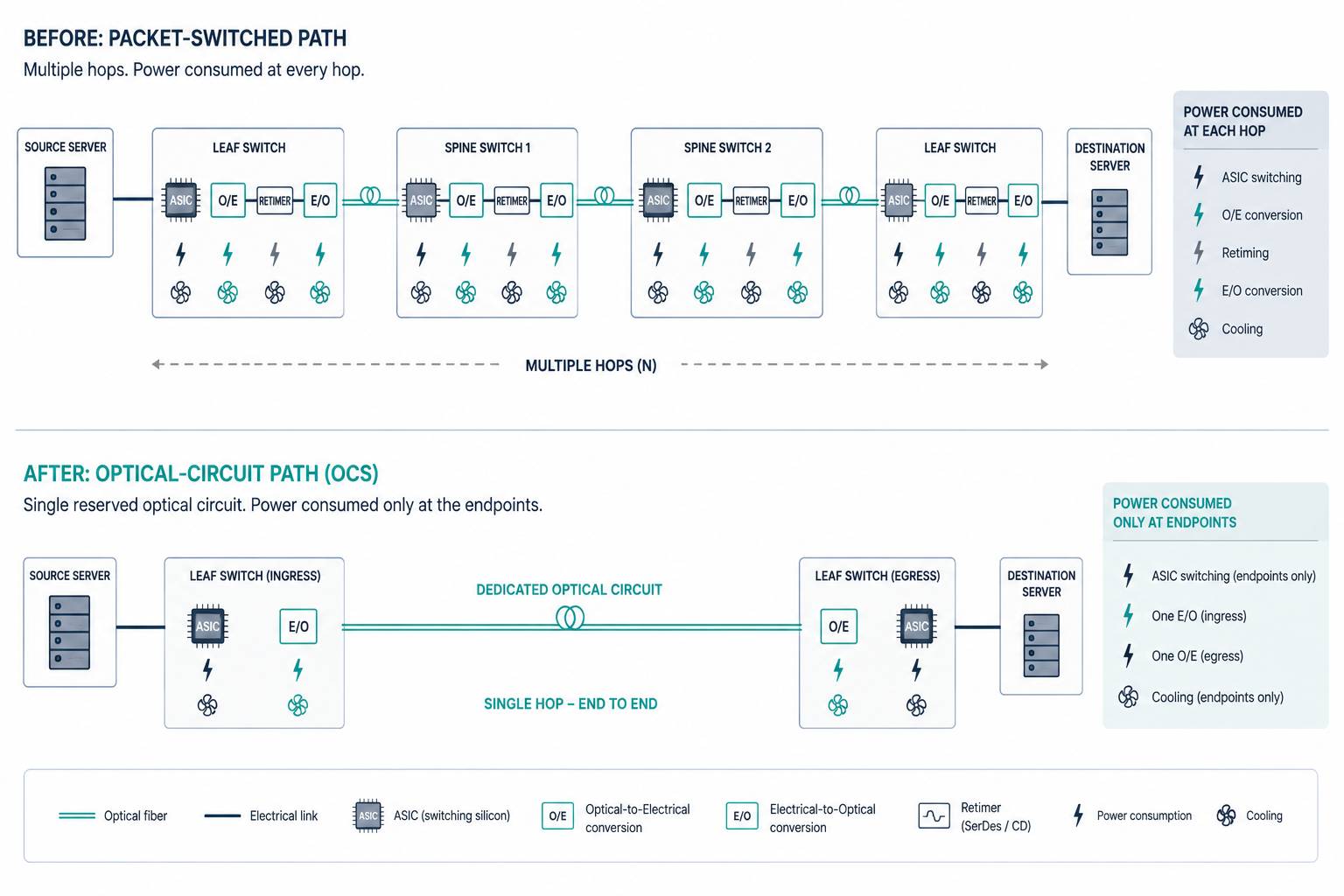
Latency tends to dominate discussions around Optical Circuit Switching, particularly in AI training networks. But for infrastructure operators, power consumption may ultimately become a stronger driver. Every packet-switching stage consumes power – not only in the switching ASIC itself, but also in optics, retimers, cooling, and supporting infrastructure. By reducing switching tiers and eliminating unnecessary O/E/O conversions, OCS can significantly reduce the network power budget of large AI clusters.
Hardware, however, only creates the potential for those savings. Whether they are actually realized depends on how efficiently the fabric is operated. Idle optical circuits continue consuming resources. Poor scheduling reduces utilization. Static circuit allocation can eliminate much of the efficiency OCS was intended to provide. Power optimization, as a result, becomes a control-plane responsibility as much as a hardware one.
The software operating on the fabric must continuously determine which circuits remain active, when resources can be reclaimed, and how topology should evolve alongside changing workload demand.
As AI infrastructure grows, the business value of OCS will increasingly depend not only on optical hardware but on the quality of the software coordinating it.
Conclusion
The technical case for Optical Circuit Switching is becoming increasingly difficult to ignore. Production deployments continue to grow, commercial hardware is maturing, and both performance and power efficiency make a compelling argument for large-scale AI infrastructure. Yet the biggest challenge is no longer the hardware. It is the software required to operate a programmable optical fabric.
Modern AI networks combine Ethernet switching, optical infrastructure, workload schedulers, telemetry systems, and automation platforms. Coordinating these domains requires far more than device management-it requires an extensible control plane capable of orchestrating infrastructure whose topology can change dynamically.
This is why programmable network operating systems such as SONiC deserve increasing attention. Rather than replacing optical controllers, SONiC provides an extensible software foundation on which organizations can build custom orchestration, telemetry, integration, and lifecycle management capabilities tailored to their infrastructure.
PLVision works across the full SONiC and optical engineering stack – from SAI bring-up and validation to production-hardened SONiC distributions with lifecycle support. If your organization is evaluating SONiC for optical infrastructure, contact our engineering team to discuss your architecture and where the real engineering work lies.
As optical networking matures, the software architecture coordinating the fabric – not the hardware spec sheet – is what will separate one deployment from another.
That’s the exact handoff point for Part 2. The next article moves from why OCS matters to what it takes to run one: the control-plane responsibilities a production optical fabric creates, where today’s commercial NOS platforms stop short, and why an extensible, SONiC-based foundation is becoming a practical requirement for teams building on OCS – not an optional add-on.
Ready to explore how SONiC can enhance your business?

- SRv6 in SONiC: Current Capabilities and Practical Limits - September 30, 2026
- Why Optical Circuit Switching Is Becoming Unavoidable in AI Datacenters - August 6, 2026
- Open Networking in Optical Infrastructure: Where SONiC Fits and What It Takes to Make It Work - June 8, 2026