
SAI Drives Product Readiness
Turn silicon bring-up into a SONiC-ready platform with a solid SAI foundation.
Simplify Complex Mapping
Align SDK capabilities with SAI through structured, reliable implementation.
Make Development Predictable
Accelerate SONiC enablement with a controlled, low-risk SAI engineering approach.
WHO THIS SERVICE IS FOR
Built for Teams That Need SAI for a Specific ASIC
ASIC Companies
We support ASIC start-ups and established silicon vendors that need SAI for a new or uncovered ASIC model and want to accelerate SONiC enablement without overloading internal SDK or platform teams.
OEMs and Solution Vendors
We help organizations building SONiC-based products that want to own the SAI layer for a selected ASIC in order to gain more control over roadmap, feature scope, integration timing, and product differentiation.
WHAT A SUCCESSFUL ENGAGEMENT DELIVERS
A Clear, Usable Enablement Result
A successful SAI engagement is not just code delivery. It is a clear, usable enablement result. Typical outcomes include:
Delivery
- Working SAI adapter for your target ASIC, integrated and validated
- Successful SONiC bring-up on the target platform
- Prioritized baseline features implemented and stabilized

Quality & Visibility
- Feature support aligned with product and business goals
- Structured validation and regression visibility throughout the engagement
- Known gaps and limitations clearly identified and documented

Readiness & Handover
- Faster demo and PoC readiness for customer and investor milestones
- Improved OEM adoption potential for the target ASIC
- Handover material so your internal team can continue with confidence
Scope of the Service
We tailor SAI Development & Integration to match your stage – from PoC bring-up to product readiness.
SAI Implementation
- SAI adapter architecture for the target ASIC
- SAI object and API implementation
- SDK capability mapping to SAI semantics
- Reusable components to accelerate delivery
SONiC Integration & Validation
- SONiC integration and platform bring-up
- Cross-layer debugging and root cause analysis
- Feature enablement based on roadmap priorities
- SAI behavior validation and regression support
Handover & Continuity
- Handover documentation and knowledge transfer
- Feature matrix and known limitations summary
- Implementation notes and design decisions
- Ongoing support for next-stage development
Work with the SONiC Experts
Benefit from PLVision's deep experience delivering enterprise SONiC solutions across industries.
FEATURE SCOPE CLARITY
Aligned to Your Priorities, Not Open-Ended
Not every project needs full SAI coverage from day one. We work with customers to define a realistic and commercially useful feature scope for the target ASIC and product stage. Depending on your needs, the engagement can focus on areas such as:
- Port and interface management
- VLAN and L2 switching
- LAG and hashing behavior
- Router interfaces, neighbors, next hops, and routes
- ACL and policy-related features
- QoS-related integration points
- Telemetry, counters, and operational visibility
- Other ASIC-specific or product-specific requirements
This allows the implementation to match business priorities instead of becoming an open-ended engineering effort.
Why Customers Choose PLVision
Deep SAI Expertise
We know the real-world details, tradeoffs, and failure modes behind production-grade SAI adapters.
Full SONiC Integration Experience
PLVision works across the ASIC SDK, SAI adapter, and SONiC layers where integration issues actually surface.
Reusable Engineering Assets
Our team brings proven code and implementation patterns to speed up delivery and reduce risk.

Independent Validation
Our SAI test framework helps catch regressions early and build confidence before milestone reviews.
VALIDATION & QUALITY
Validation Built In, Not Added Later
SAI quality is not about compiling code or passing a few manual checks. It is about consistent behavior, stable integration, and confidence that changes do not break existing functionality. Our validation approach helps customers:
- Verify implemented SAI behavior systematically across feature areas
- Detect regressions earlier – before they reach demos or customer reviews
- Improve readiness for PoCs, demos, and release milestones
- Normalize SAI behavior across hardware platforms for consistent SONiC operation
- Build a stronger quality foundation for future feature growth
For customers building long-term SONiC products, validation also helps transform SAI from a one-time integration effort into a maintainable engineering asset.
Engagement Models
Choose the starting point that matches your program stage. Each model can scale as your needs evolve.
Assessment & Feasibility
Validate readiness, identify gaps, and define a practical scope before committing.
PoC & Bring-Up
Move quickly to a working SONiC demo for evaluations or proof-of-concept reviews.
Baseline SAI Enablement
Build core SAI functionality with a structured implementation and validation approach.
Stabilization & Hardening
Improve an existing implementation with stronger validation, regression control, and production readiness.
Ongoing Extension & Support
Expand features, maintain the adapter, and support long-term product evolution.
Full SONiC Product Bundle
Combine SAI Launchpad with SONiC integration, feature enablement, hardening, and ongoing support.
DELIVERY PROCESS
How We Work With You
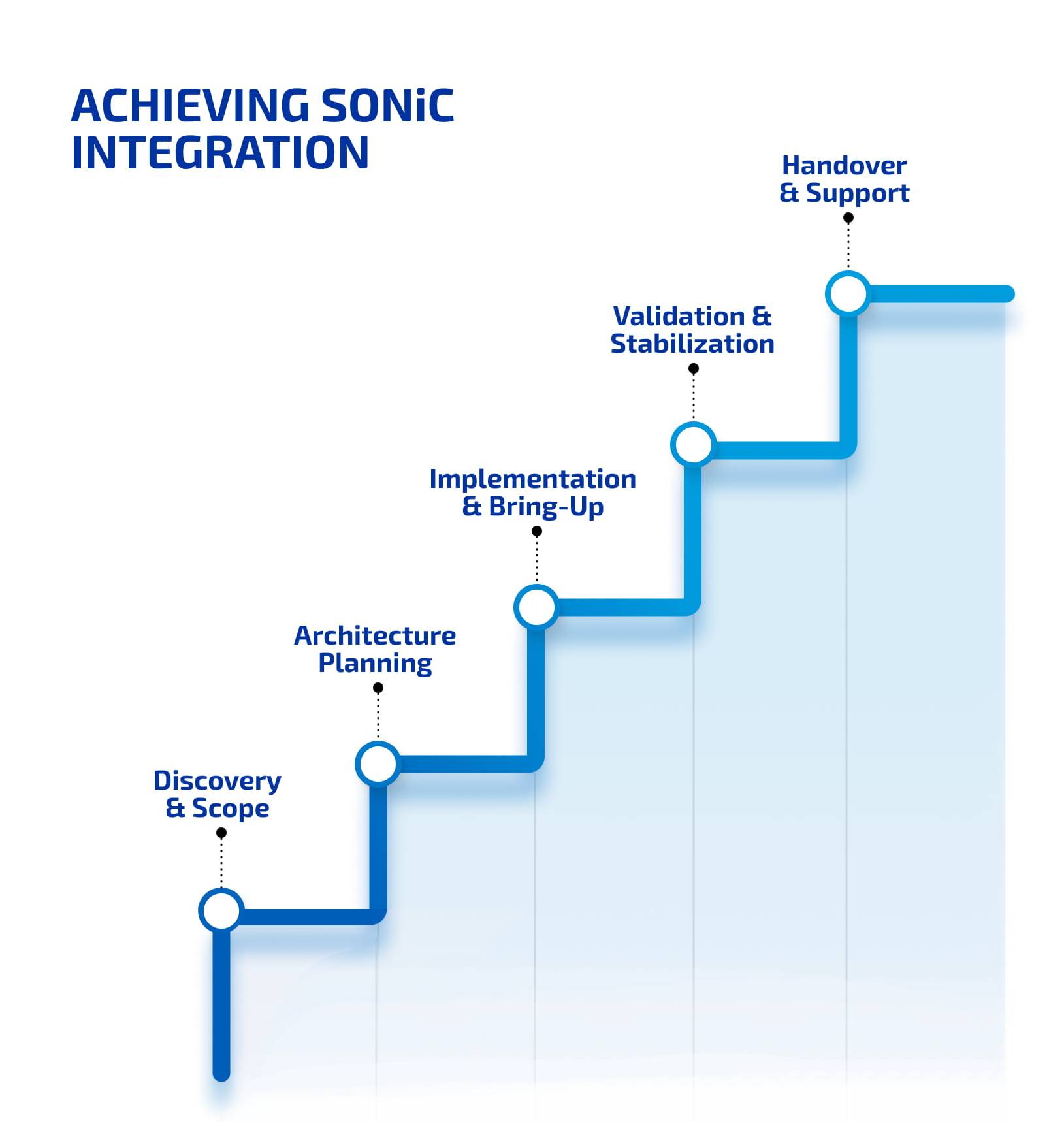
01. Discovery & Scope Alignment – Review your ASIC, SDK maturity, hardware access, SONiC version, feature priorities, and milestones.
02. Architecture & Implementation Planning – Define the adapter structure, feature-mapping approach, dependencies, and validation strategy.
03. Implementation & Bring-Up – Implement the SAI layer, integrate with the SDK, and support early SONiC bring-up on the target platform.
04. Validation & Stabilization – Verify behavior through structured testing, analyze failures, fix regressions, and improve delivery confidence.
05. Handover & Next-Stage Support – Provide handover material, knowledge transfer, and optional continued support for feature expansion.
What We Need From the Customer
A successful SAI engagement usually depends on clear access to the right technical inputs. We scope based on what is available and advise on how to fill gaps. These often include:
- Target ASIC and hardware details
- SDK access and documentation
- Lab access or hardware availability
- Target SONiC version or integration environment
- Prioritized feature list
- Expected milestones and business goals
By aligning early on inputs and scope, we make delivery more predictable and reduce wasted cycles on both sides.
Typical Deliverables
Depending on the engagement scope, deliverables may include:
SAI adapter source code and integration components

Feature support matrix

Implementation notes and known limitations

Validation and regression test reports

Issue analysis and stabilization recommendations
Handover and knowledge-transfer materials
Optional roadmap suggestions for next-stage development
Standalone Service or Part of a Broader Bundle
Standalone
A targeted service for customers who primarily need SAI adapter implementation, integration, and validation for a specific ASIC – without committing to a broader SONiC program.
As Part of a Broader Bundle
For customers building a full SONiC-based product, SAI Launchpad can be combined with:
- SONiC platform integration and customization
- NOS feature enablement
- System-level hardening
- Maintenance and support
- Troubleshooting and knowledge transfer
This makes SAI the enabling foundation within a broader product-development path.
SONiC-Based Custom Product Development
PLVision specializes in developing custom SONiC-based distributions tailored to the specific functionality required for your unique use case.
When This Service Is the Right Fit
This service is especially relevant when:
- You have a new ASIC and need SAI to enable SONiC
- A specific ASIC model still has no SAI support
- Internal teams are overloaded with SDK, platform, or customer work
- You need faster demo or PoC readiness
- You want stronger regression coverage and validation
- You want more control over the software layer for a chosen ASIC
- You are building a broader SONiC-based product and need the hardware-enablement layer in place
- You face OEM or customer demand for SONiC support and do not have bandwidth to execute internally
- You need a measurable validation story for customer or investor confidence
Ready to Accelerate SAI Enablement for Your ASIC?
Let’s discuss your target ASIC, SDK maturity, feature priorities, and SONiC integration goals.
Common Questions, Straight Answers
Can you work with an immature SDK?
Yes – though scope and pace depend on SDK maturity. An assessment phase is often the best starting point.
Can you start from a partial SAI implementation?
Yes. We review existing code, identify gaps, improve architecture, continue implementation, and strengthen validation.
Is this only for full production programs?
No. The service can start with assessment or PoC bring-up and later expand into broader product-readiness work.
We already have an internal SAI team – why do we need this?
Internal teams build components. We ensure the full chain works in SONiC. Integration issues appear at the intersection of SDK, SAI, and SONiC – not within a single layer.
Can this be part of a larger SONiC project?
Yes. SAI Development & Integration fits naturally into a broader SONiC product-development or platform-enablement program.
Do you also help with validation?
Yes. Validation is one of the core parts of the service and a major differentiator in our offering.
We are still early-stage – is now the right time?
Early validation reduces later cost. Fixing SAI architecture after OEM engagement begins is expensive. An assessment or PoC scope is a low-risk way to get the foundation right.
What if we focus on silicon performance, not SONiC integration?
Performance without stable software cannot be deployed at scale. SAI is what makes your silicon usable in real customer environments.