Mainline SONiC now has the SRv6 building blocks – here’s what they enable today, and what still takes custom engineering to ship.
For a couple of years, the interesting question about SRv6 in SONiC was whether it worked at all. That question is settled. Microsoft runs SRv6 uSID across Fairwater, an AI fabric reportedly connecting 500,000 GPUs. Alibaba uses SRv6 for data center interconnect. LINE operates SRv6 in its WAN. The technology has clearly moved beyond experimental deployments.
So the question worth asking has changed. It’s no longer “Does SONiC support SRv6?” Instead, it is “What does current mainline support actually enable – and what additional engineering is required to build a deployable solution on your own platform?”
Here’s the short answer: the core SRv6 building blocks are now available in mainline SONiC, but they currently enable only a small number of complete deployment scenarios. More advanced capabilities remain outside the current mainline feature set.
Considering a switch to open-source networking?
Explore the reasons to choose an open-source NOS like SONiC, along with a breakdown of the Total Cost of Ownership (TCO) for both proprietary and open-source solutions.
Why SRv6 Matters Now
The commercial case for SRv6 is simple: path information travels in the packet instead of being installed hop-by-hop, which shrinks the control-plane surface a network has to maintain. What’s changed is which use case is actually driving adoption.
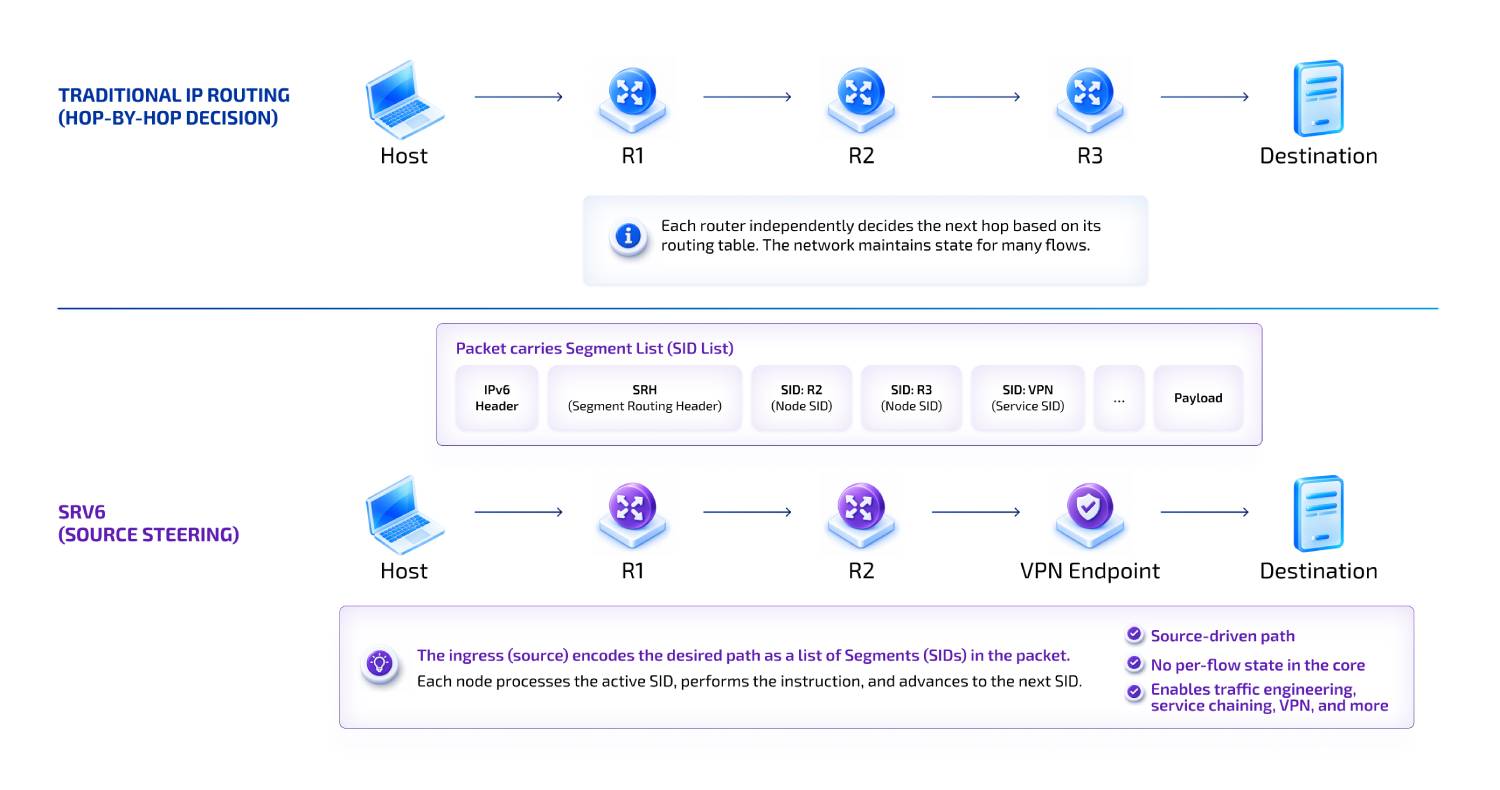
Figure 1 – Segment Routing vs Traditional IP Routing
Two years ago, the pitch was VPN consolidation – replacing an MPLS underlay with an IPv6-native one. That’s still real, and it’s one of the two end-to-end solutions enabled by current mainline SRv6 support. But the center of gravity has shifted toward something newer: deterministic path placement inside AI training fabrics. ECMP’s per-flow hashing breaks down when a handful of massive, long-lived RoCEv2 flows collide on the same hashed path and create hot spots. SRv6 uSID lets an SDN controller assign each flow an explicit path instead – exactly the problem Microsoft’s Fairwater deployment was built to solve.
SRv6 also shows up in broader traffic-engineering and protocol-consolidation conversations, collapsing roles historically split across VXLAN, MPLS, and NSH into a single IPv6 data plane. Those are real drivers, and they’re increasingly backed by public large-scale deployments rather than lab demos.
Whether mainline SONiC can support these applications today depends on which specific capabilities are available – something the following table summarizes briefly.
SRv6 Capabilities in Mainline SONiC
Before getting into deployment maturity, it’s worth separating two different questions: what building blocks exist in mainline SONiC, and what complete deployment scenarios they currently support. The table below covers the first question.
Table 1 – SONiC SRv6 Mainline Status
| SRv6 Capability | Current Mainline Status | Notes |
|---|---|---|
| SRv6 Data Plane | Implemented | IPv6 Segment Routing Header (SRH) forwarding and encapsulation |
| IS-IS / BGP SRv6 Control Plane | Partially Implemented | BGP SRv6 L3VPN: dataplane + partial config. IS-IS SRv6: FRR-only, no SONiC config |
| Node-SIDs (uN) | Implemented | Node endpoint behaviors |
| Prefix-SIDs (uDT4 / uDT6 / uDT46) | Implemented | L3VPN endpoint behaviors |
| Adjacency-SIDs (End.X / uA) | Implemented | Link-specific forwarding behaviors |
| SRv6 Tunnel Endpoints (H.Encaps.Red) | Implemented | Tunnel encapsulation and decapsulation |
| Static SRv6 Policy Steering | Implemented | Controller-programmed static SRv6 paths |
| Network Programming Functions | Partially Implemented | Core endpoint behaviors implemented; full RFC 8986 function set is not yet available |
| Dynamic Traffic Engineering | Not Available | No dynamic SR Policy computation or optimization |
| EVPN / L2VPN over SRv6 | Not Available | L2 service support not available in current mainline |
| TI-LFA | Not Available | Fast reroute support not available |
| SBFD | Not Available | Fast failure detection not available |
This is the capability inventory – the pieces currently available in the mainline SONiC codebase. The table describes individual SRv6 capabilities, while the next section explains how they combine into complete end-to-end solutions and where additional engineering is still required.
Download our white paper to learn more about SONiC's capabilities and unlock its potential for your business. Discover how SONiC can revolutionize your network infrastructure, offering unparalleled flexibility, scalability, and cost optimization.
What Current SRv6 Support Enables?
SRv6 uSID work in SONiC started in 2021, and it’s no longer a side project. SRv6 uSID development in SONiC is no longer experimental. It is an active multi-vendor effort spanning SONiC, FRRouting and SAI, with hundreds of merged pull requests and contributions from Cisco, Microsoft, Alibaba, NVIDIA, Intel, Broadcom, LINE and 6WIND. The most recent mainline cycle, SONiC 202505, alone merged 122 PRs across those three layers. This is an actively funded, multi-vendor effort under continuous development.
Taken together, the implemented capabilities shown in the table enable two complete end-to-end solutions today: L3VPN delivery over an SRv6 underlay, and static, controller-driven deterministic path placement. Both are backed by more than a demo-named, at-scale operators deploying them in live networks, on a standards-aligned implementation with real multi-vendor contribution behind it. That’s what lowers the technology risk for a product built around either one.
That maturity spans the full SONiC stack, from configuration through FRR and SAI. The distinction that matters going forward isn’t within that proven core-it’s between a standardized interface and an actual hardware implementation, which becomes the real question for anything still outside mainline.
The ecosystem’s pace backs this up. FRR 10.5, released in November 2025, added multi-locator support and a newer compression format aimed at the same AI-fabric deployments. SONiC 202605, branched in June 2026, is carrying that work toward the next mainline release. This is an actively maintained, fast-moving part of the project, with ongoing development driven by the needs of hyperscale operators and service providers.
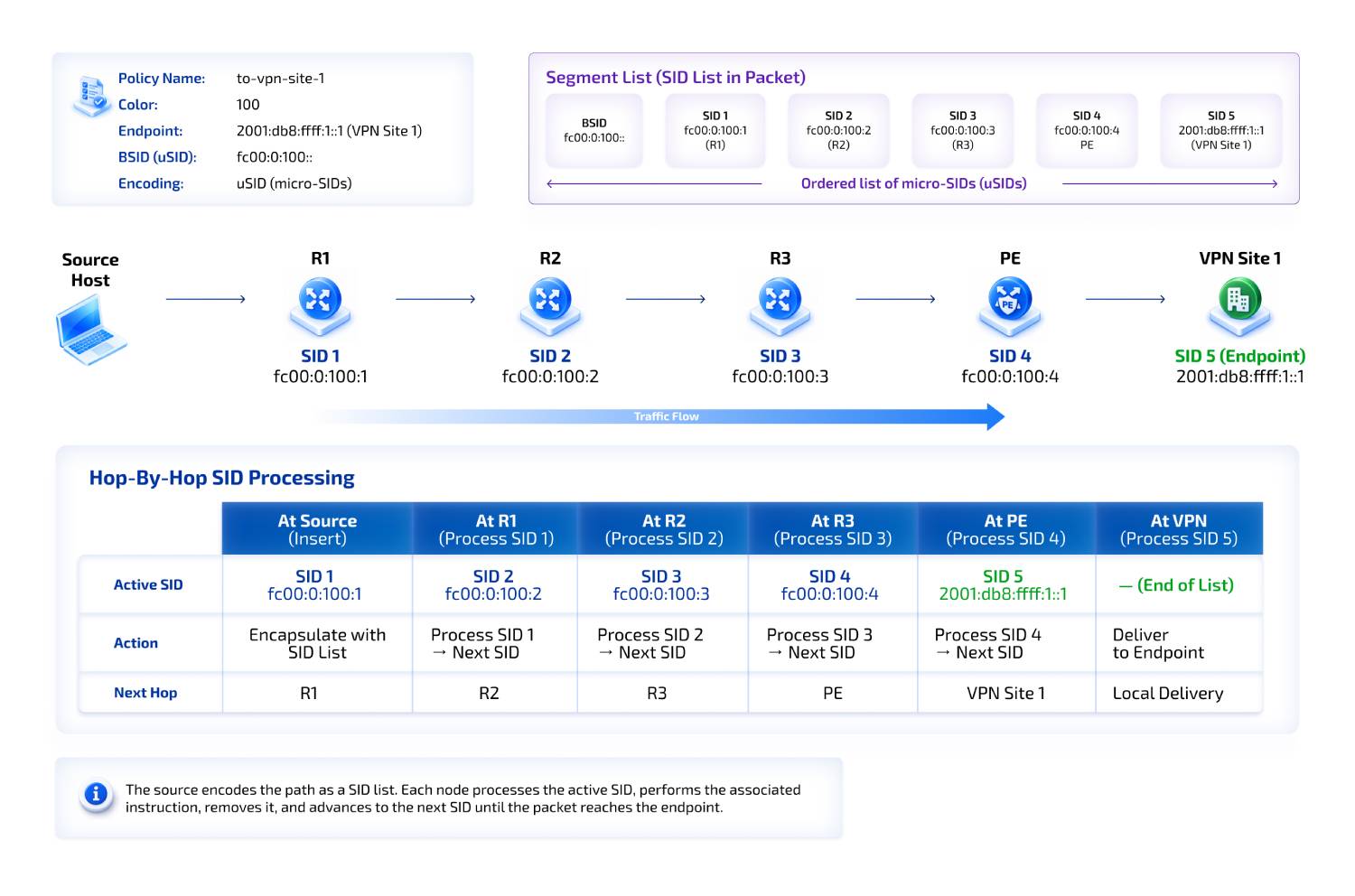
Figure 2 – SR Policy Example
One clarification is worth making. The current implementation should not be interpreted as complete SR Policy support. Today’s AI-backend deployments rely on explicit, controller-programmed SR Policies, where an external SDN controller computes the paths and installs them on the headend devices. This differs from the dynamic SR Policy model defined in RFC 9256, where candidate paths may be computed and continuously reoptimized based on optimization objectives and network constraints. The two approaches address different operational requirements and should be evaluated independently.
What Is Still Missing?
The remaining gaps are specific, and mostly tracked as an explicit upstream roadmap. Four are worth knowing about.
- L2VPN and EVPN L2 services are still ahead of mainline. Today’s functionality is L3-focused; L2VPN endpoint behaviors and EVPN-based services aren’t yet complete in the mainline stack.
- Dynamic, constraint-based traffic engineering – where the network exposes topology and a controller computes constrained paths dynamically – isn’t yet in mainline. What’s proven today is the static model, and that’s a genuinely different architecture, not an earlier version of the same one.
- TI-LFA fast reroute, the sub-50ms local-repair mechanism many operators expect from modern IGP deployments, isn’t yet part of the mainline SRv6 feature set.
- SBFD, a lighter-weight failure-detection model built for SRv6’s path cardinality, is similarly still outside mainline.
None of these are stalled – SID compression beyond F3216, for instance, already has control-plane support in FRR 10.5 even though broad hardware validation hasn’t caught up. That’s a pattern worth remembering across this whole list: control-plane progress tends to outpace forwarding-plane readiness, so a feature can look closer to done than it is if you’re only reading release notes.
SONiC-Based Custom Product Development
PLVision specializes in developing custom SONiC-based distributions tailored to the specific functionality required for your unique use case.
What This Means for Product Teams
If you’re scoping a product against SONiC’s SRv6 support, here’s what the maturity picture means for you:
- Building L3VPN over an SRv6 underlay? You’re on solid ground. This is low-risk, and your remaining questions are about your specific ASIC, not the protocol.
- Building AI backend networking with deterministic path placement? Same answer. This is the flagship use case – proven architecture, with silicon validation as the only real open item.
- Need Dynamic Traffic Engineering? Budget for it. This isn’t an extension of what’s already proven – it’s a different control-plane architecture, and it’s only worth building if your use case genuinely requires the network to compute paths itself, rather than receiving them from a controller. Multi-tenant WAN and multi-domain interconnect are where that need tends to be real.
- Need L2VPN or EVPN? Treat it as a gap to plan around. This is meaningful new engineering, not integration of an existing capability.
- Need TI-LFA or SBFD? Same answer – plan around it, and validate against what your target ASIC’s forwarding pipeline supports.
Across all five, one variable explains most of the risk you’ll actually encounter: your ASIC and its SDK, not SRv6 protocol maturity, which is comparatively settled. A defined interface doesn’t confirm your vendor’s silicon implements the behavior behind it. That risk is low for the two deployment scenarios described earlier, given how many silicon vendors have already contributed to and validated that core. For the remaining capabilities, don’t assume parity with the reference deployments – check your specific silicon generation before you commit a plan to it.
Conclusion
SRv6 uSID in SONiC has crossed a real threshold. Mainline SONiC already contains a substantial set of SRv6 building blocks – the data plane, core endpoint behaviors, and both static and dynamic control-plane distribution – deployed at hyperscale by leading network operators, backed by a genuinely multi-vendor contributor base and a fast-moving release cadence. For L3VPN and deterministic AI-fabric path control, the answer to “does SONiC support SRv6?” is a proven yes.
What that doesn’t change is the engineering reality for any specific product: a rich capability inventory isn’t the same as a complete end-to-end solution, and proven at hyperscale isn’t the same as ready on your ASIC. The remaining gaps – L2VPN/EVPN, dynamic constraint-based TE, TI-LFA, next-generation compression, SBFD – are real, and closing them looks different depending on how far your target silicon sits from the platforms these capabilities were built on.
PLVision builds and maintains production-grade SONiC solutions, including custom SONiC-based product development for teams closing gaps like TI-LFA, SBFD, or L2VPN/EVPN that mainline doesn’t cover yet.
Sources
Official design documentation
- SONiC SRv6 High-Level Design – sonic-net/SONiC, doc/srv6/srv6_hld.md
- SONiC SRv6 uSID High-Level Design – sonic-net/SONiC, doc/srv6/SRv6_uSID.md
- SONiC SRv6 VPN High-Level Design – sonic-net/SONiC, doc/srv6/srv6_vpn.md
- SONiC SRv6 Static Config High-Level Design (SDN-controller-driven programming) – sonic-net/SONiC, doc/srv6/srv6_static_config_hld.md
- SONiC 202505 release overview – sonicfoundation.dev
- SONiC SBFD High-Level Design Pull Request
Ecosystem status and release tracking
- SAI/SONiC SRv6 status hub – segment-routing.net/open-software/sonic
- FRR 10.5 SRv6 uSID enhancements for SONiC – segment-routing.net, Nov 2025
- Open SRv6 community implementation tracker – srv6.md/implementations/sonic
Production deployment references
- Microsoft: SRv6 powers the Fairwater AI data center – segment-routing.net, Oct 2025
- “The World’s Largest AI Network: How Microsoft Built Fairwater” – YouTube
- Microsoft: Building a source-routed AI backend network with SRv6 (OCP EMEA 2025) – segment-routing.net
- “AI Backend: Deploying SRv6 uSID and SONiC for Deterministic Load Balancing” (NANOG96, Feb 2026) — YouTube / NANOG96 PDF
- “Towards Fully-Controllable Packet Steering for AI Backend Networks” – Microsoft Research, Jan 2026
- SONiC SRv6 VPN deployment for Predictable-WAN (LINE Corporation) – YouTube
- Alibaba + Microsoft SRv6 at OCP 2025 – LinkedIn
- SONiC 202605 branch cut – LinkedIn
Demos and hands-on builds
- “Building an SRv6 uSID Data Center Fabric with SONiC” (12-node BGP/uSID PoC with configs) – segment-routing.net blog
- Demo: SRv6 uSID in SONiC with Cisco Silicon One – segment-routing.net
- Open Source Summit EU 2025 demo (Cisco + Microsoft) – segment-routing.net / config repo
- “SRv6 in SONiC: Deterministic Path Placement in AI Backends” (OSS EU 2025) – YouTube
- Cisco SONiC on 8000 Series documentation – developer.cisco.com/docs/sonic
Ready to explore how SONiC can enhance your business?

- SRv6 in SONiC: Current Capabilities and Practical Limits - September 30, 2026
- Why Optical Circuit Switching Is Becoming Unavoidable in AI Datacenters - August 6, 2026
- Open Networking in Optical Infrastructure: Where SONiC Fits and What It Takes to Make It Work - June 8, 2026