Data center sustainability in 2026 sits between two competing forces: the relentless expansion of AI compute on one side, and the energy bills, carbon commitments, and regulatory pressure it generates on the other.
The sustainability imperative for data centers is settled. The open questions are which levers actually matter, which ones are being underused, and what the path forward looks like for operators who need to act now.
In this article, you will discover the five forces reshaping data center sustainability, why the network layer remains one of the most underappreciated energy variables in the infrastructure stack, and how PLVision’s approach to lightweight open networking software – through SONiC Lite and production-grade lifecycle support – creates structural efficiency gains that proprietary NOS stacks and broad-brush energy investments tend to miss.
Considering a switch to open-source networking?
Explore the reasons to choose an open-source NOS like SONiC, along with a breakdown of the Total Cost of Ownership (TCO) for both proprietary and open-source solutions.
The Data Center Sustainability Math Nobody Wants to Say Out Loud
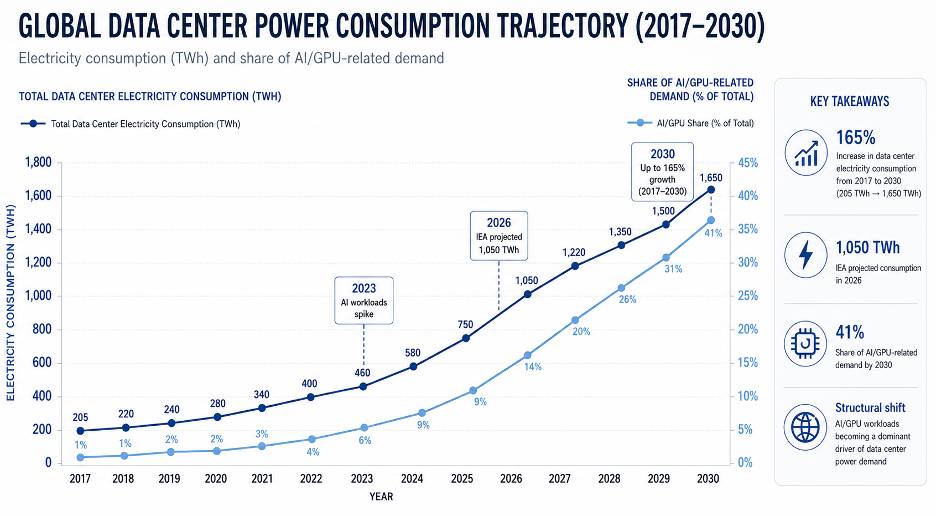
The International Energy Agency projects global data center power consumption reaching approximately 1,050 TWh by 2026. In the United States alone, that translates to around 6% of total national electricity demand. The EU’s data center footprint was 100 TWh in 2022 and is trending toward 150 TWh by 2026.
A single hyperscale facility consumes as much electricity as 100,000 households. A 100 MW campus can consume around 2.5 billion litres of water per year – comparable to the annual water needs of 80,000 people.
And this is before the AI wave fully lands. Global data center power demand is projected to rise 50% by 2027 and up to 165% by 2030, driven primarily by AI workloads. The hardware running these workloads – GPUs and specialized accelerators – is significantly more power-intensive than the CPUs they’re displacing.
Regulatory responses are accelerating alongside the growth. The European Commission is developing a data center energy and water use labeling framework due in 2026. What’s been a voluntary ESG reporting exercise is becoming a compliance requirement.
Five Converging Forces Shaping the Sustainability Agenda
This energy pressure is driving five distinct forces to converge at once.
- Energy mix transformation. Solar, wind, and battery storage have become cost-competitive enough that the bottleneck has shifted from technical capability to procurement decisions. Next-generation geothermal and nuclear are entering serious consideration for operators who need clean firm power to back intermittent renewables. In 2024, renewable energy procurements for data center purposes reached record levels.
- Advanced cooling. Traditional HVAC cannot keep up with the thermal density of modern AI infrastructure. Direct-to-chip liquid cooling, immersion cooling in dielectric fluids, and two-phase cooling systems have demonstrated cooling energy reductions of 50–60% compared to conventional air-based approaches. These systems also open the door to waste heat recovery – routing thermal output to district heating networks, rather than dissipating it.
- Metrics expanding beyond PUE. Power Usage Effectiveness remains a foundational metric, but the industry’s measurement vocabulary is growing. Carbon Usage Effectiveness (CUE) factors in local grid emissions intensity. Water Usage Effectiveness (WuE) accounts for cooling-related water consumption. Life cycle assessments (LCA) are increasingly required to quantify embodied carbon – the emissions locked into hardware manufacturing before a device is ever powered on. Organizations that only optimize PUE while ignoring these upstream and downstream factors are managing an incomplete picture.
- Hardware lifecycle and circular economy. Equipment manufacturing contributes roughly 24% of a data center’s lifetime carbon footprint. The industry’s typical 3-to-5-year hardware refresh cycle generates millions of tons of electronic waste annually – with a documented recycling rate of only about 22%. Extending hardware lifecycles, refurbishing rather than replacing, and treating hardware as a long-lived capital asset are becoming sustainability levers with consequences that extend well beyond cost management.
- Market economics. The global green AI data center market is projected to grow from $63 billion in 2025 to $123 billion by 2035. Sustainability is no longer exclusively a cost center or a reporting obligation. It’s increasingly a capital formation signal – factor in investor ESG requirements, utility pricing dynamics, and the regulatory trajectory, and the economics of efficient infrastructure are converging with the business case.
The Overlooked Lever in Data Center Sustainability: Network Infrastructure
Most sustainability coverage lands on the obvious targets – servers, GPUs, cooling systems. These are the right targets. But there is a structural blind spot in most data center sustainability analyses, and it’s significant: the network layer.
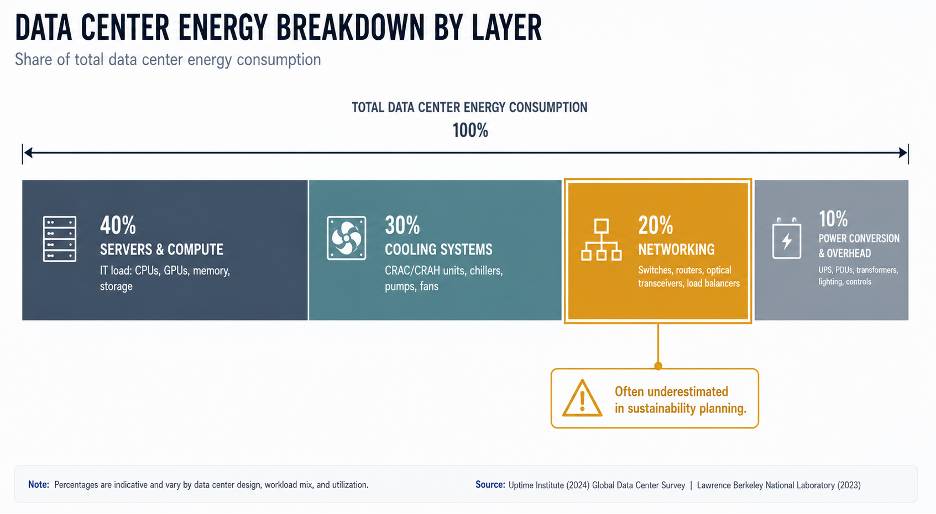
Data center networking accounts for roughly 20% of total facility energy – a share comparable in scale to power conversion overhead, yet receiving a fraction of the sustainability engineering attention directed at servers and cooling. The network functions as a continuous, high-overhead energy consumer, active and drawing significant power regardless of traffic load.
What makes this more structurally significant is the load-proportionality problem. Traditional network switches draw up to 90% of their peak power regardless of actual traffic throughput. A switch running at 10% utilization at 2 AM consumes nearly the same energy as one running at full capacity during peak hours. The energy budget doesn’t scale with demand the way server workloads increasingly do.
And here’s the trajectory argument that doesn’t get enough attention: as server efficiency improves – as GPUs deliver more compute per watt, as hypervisors get leaner, as infrastructure automation reduces overhead – the relative contribution of servers to total facility power draw decreases. The network layer, which has not received the same engineering attention, becomes a proportionally larger share of the sustainability problem over time. The fraction grows even when the absolute wattage stays flat.
Power savings in the network flow directly to the operational expense line. At current energy pricing trajectories in both the US and EU, those savings compound year over year across the equipment’s operational lifetime.
Why the NOS Running Your Switches Matters for Sustainability
If the network layer is an underappreciated energy variable, the software running on that network deserves even more attention than it currently gets.
A heavyweight, unoptimized network operating system keeps CPU cores, memory controllers, and storage interfaces active at high frequencies even when the switch is handling minimal traffic. The base power draw of a switch depends on both hardware specifications and what the software is continuously asking that hardware to do.
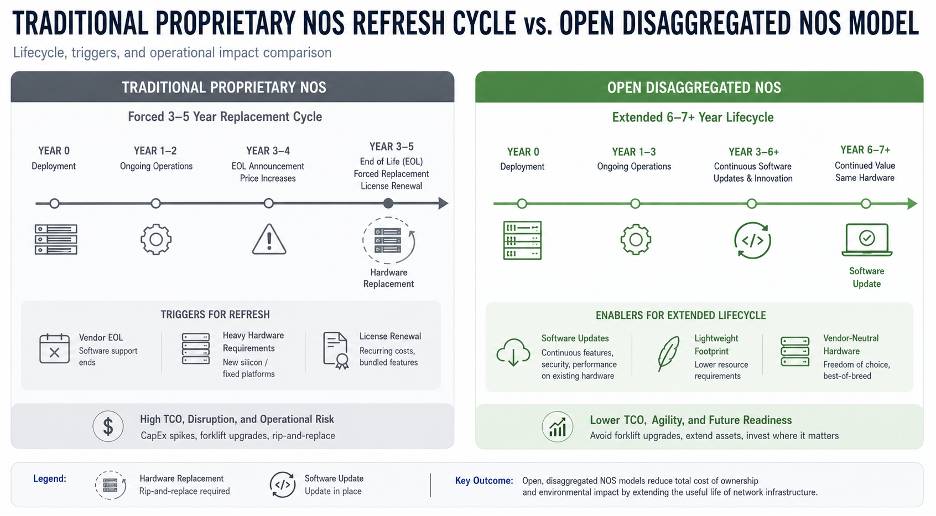
Traditional proprietary NOS architectures compound this in another way: artificial hardware obsolescence. When a vendor terminates support for a NOS version or ships an update that exceeds the resource limits of older hardware, operators face a forced capital refresh cycle. The trigger is a vendor licensing or support boundary – a commercial constraint that forces hardware retirement years before the equipment reaches its operational limits. Each replaced switch carries with it the embodied carbon of manufacturing a replacement, while the retired device enters a waste stream with limited recycling infrastructure.
The disaggregated, open networking model changes this calculus on both fronts. Decoupling the software lifecycle from the hardware lifecycle means the hardware can remain operational longer – updated via software, not replaced via procurement. And when the software is purpose-built to run on resource-constrained hardware rather than demanding high-performance control planes, the energy profile of the switch changes accordingly.
SONiC Lite: Right-Sized Software for Right-Sized Hardware
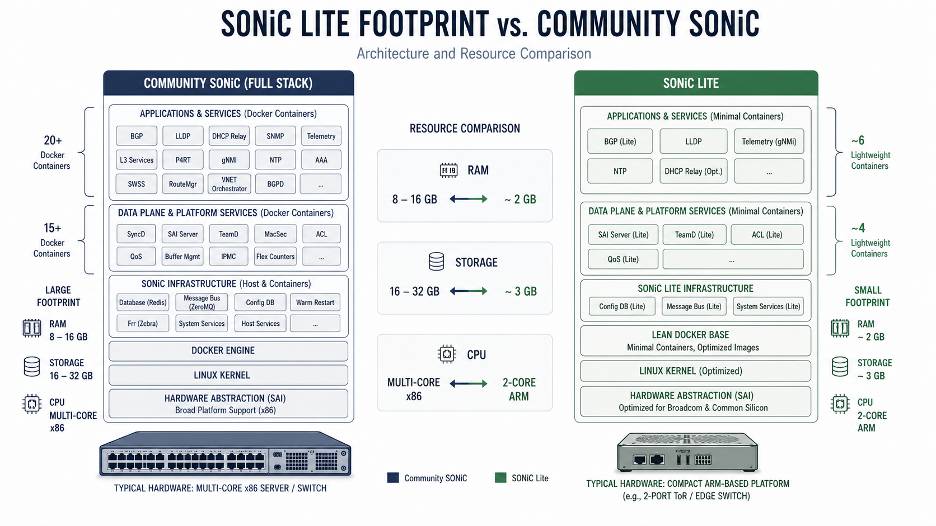
The SONiC ecosystem – originally developed at Microsoft and now maintained under the Linux Foundation – has become the reference architecture for disaggregated open networking in hyperscale data centers. But Community SONiC, for all its advantages, was built with hyperscale hardware assumptions: high-performance multi-core x86 processors, 8–16 GB of RAM, 16–32 GB of storage. These requirements make it unsuitable for access, edge, management, and campus switches – the distributed, numerous, energy-consuming nodes that constitute a large share of enterprise and mid-market network infrastructure.
PLVision, a networking software engineering company with over 18 years of open networking software engineering experience, built SONiC Lite to address this gap. SONiC Lite is an enterprise distribution of SONiC optimized for platforms running 2-core ARM processors, approximately 2 GB of RAM, and around 3 GB of storage – a 50–80% reduction in compute and memory footprint compared to standard Community SONiC. That reduction comes from rebuilding the software architecture – optimized Docker base images, stripped kernel modules, eliminated non-essential background processes, and refactored daemon loads – while preserving the core functionality operators need.
SONiC Lite Free Demo
Implement SONiC on cost-effective platforms with SONiC Lite
The sustainability implications are direct. Lighter software running on modest control-plane processors allows those processors to spend more time in lower-power C-states and operate at reduced P-state frequencies. Reduced CPU and memory activity lowers thermal dissipation within the switch chassis, which in turn reduces internal cooling fan activity. Together, these amount to structural changes in the switch’s base energy profile.
The hardware-side implication runs parallel. SONiC Lite’s resource requirements allow OEM and ODM hardware vendors to design access and campus switches with lower-specification control planes – smaller, less power-intensive CPUs and smaller memory modules. Hardware with a reduced bill of materials has a lower embodied carbon footprint before it’s ever powered on. The sustainability benefit reaches into the supply chain – an upstream gain that precedes any operational deployment.
Across a distributed enterprise or service provider network – where hundreds of access switches operate continuously, often at low utilization, running bloated proprietary NOS stacks on hardware sized for that overhead – the aggregate impact of right-sizing both the software and the hardware is substantial.
There is also the lifecycle argument. SONiC Lite’s lightweight architecture allows it to run on hardware that would otherwise be deemed incompatible with heavier NOS updates. That extends the useful operational life of existing switching infrastructure from the industry-standard 3-to-5-year cycle toward 6-to-7 years. Extending the lifecycle of a switch from 4 to 7 years reduces its annualized embodied carbon by nearly 43%, while keeping the copper, aluminum, and rare-earth materials in the device rather than in the waste stream.
Seeking out SONiC Distribution
for cost-effective management
and access switches?
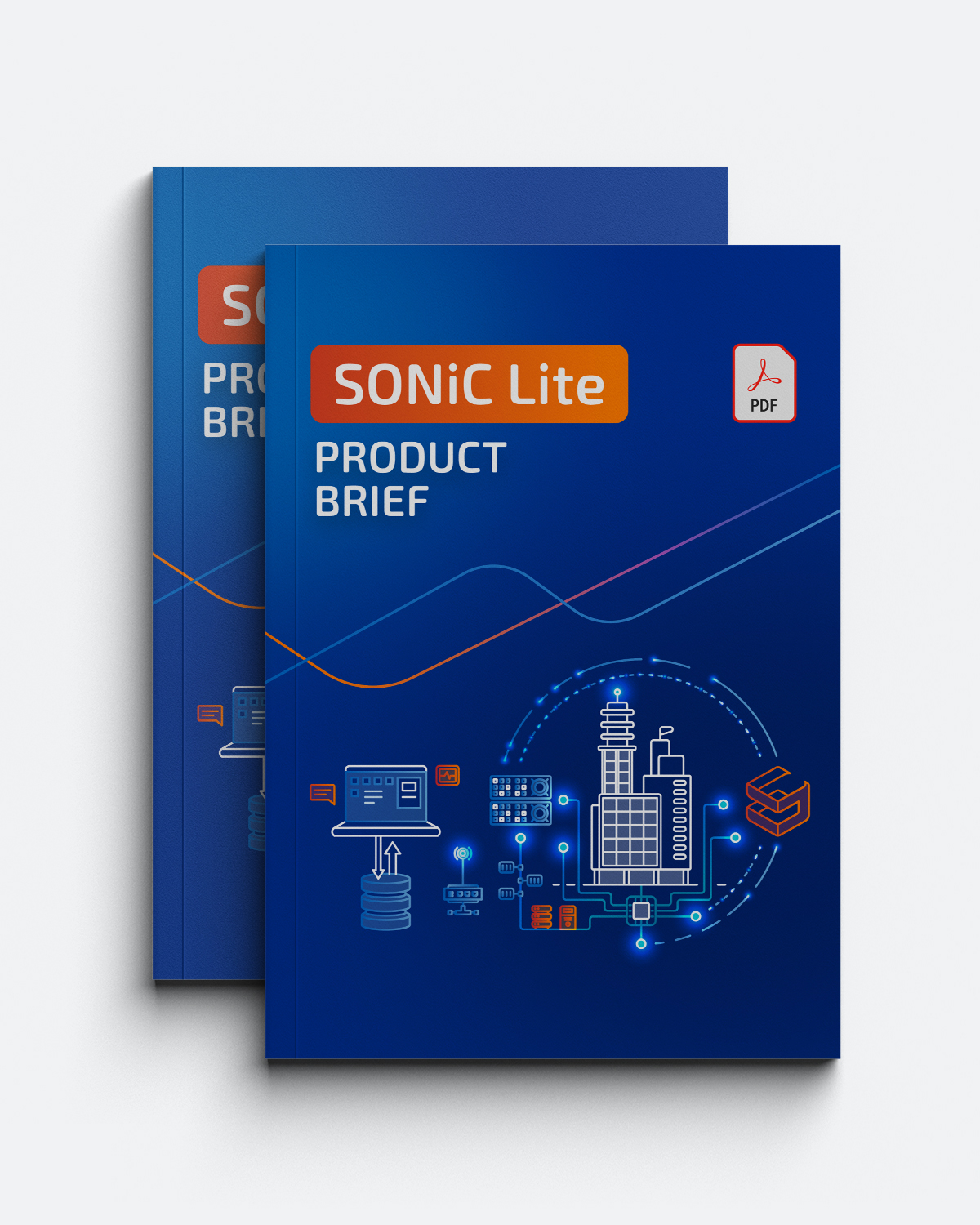
Download the SONiC Lite product brief to explore detailed features, supported use cases, and the current hardware compatibility list.
One additional capability worth noting in the edge and access context: SONiC Lite includes full PoE++ support (IEEE 802.3af/at/bt, up to 90W per port) with granular per-port power management via CLI. At the access layer – where switches serve as the power distribution hub for wireless access points, cameras, and IoT devices – the ability to set dynamic power limits, configure priority levels, and enable LLDP-PoE negotiation so each port delivers power matched precisely to what the endpoint requires – eliminating the energy lost to over-provisioning. Centralized PoE management is a direct, measurable energy efficiency mechanism at the network edge.
Extending the Discipline Across the Full Stack
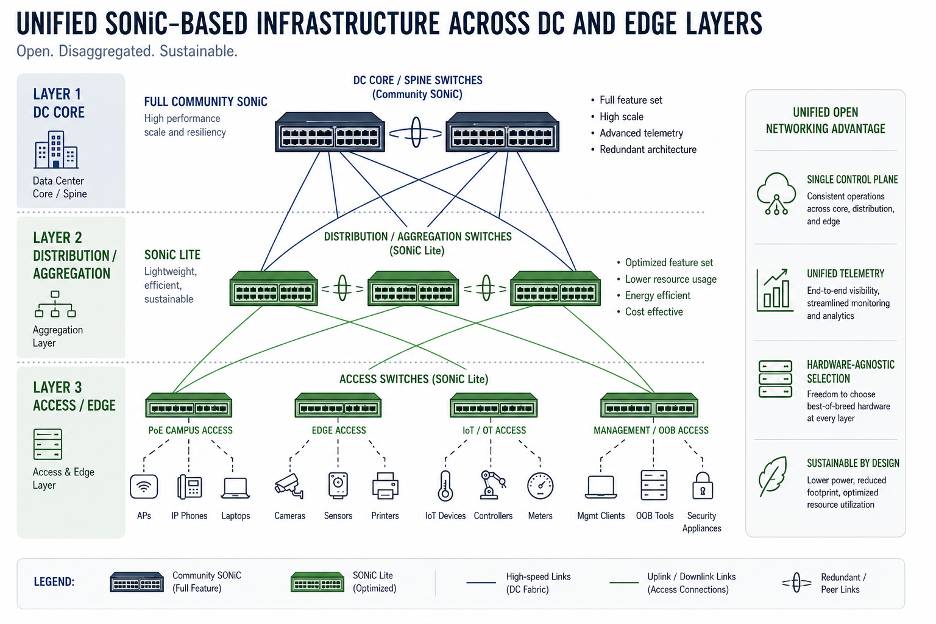
Sustainable networking spans every layer of the stack. Data center operators running SONiC at the core and distribution layers face a parallel challenge: the gap between the flexibility of Community SONiC and the operational requirements of production environments – lifecycle management, security patch cadence, hardware qualification, structured support.
Learn more about SONiC's architecture, its capabilities, and explore inspiring success stories of SONiC deployments across diverse network environments.
This is where PLVision’s SONiC LTS offering addresses a different but related sustainability argument. SONiC LTS provides a production-oriented long-term support structure for SONiC deployments at the DC core: a fixed software baseline, qualified hardware combinations, CI-gated releases, security patches, approved backports, and structured support engagement. For DC operators who cannot maintain a full NOS engineering organization internally, this lifecycle discipline means they can operate SONiC in production without becoming their own NOS maintainers – and without the forced refresh cycles that come from running unsupported Community SONiC builds.
For organizations requiring a custom SONiC distribution – purpose-built for telco environments, xPU/SmartNIC optimization, or specific product differentiation strategies – PLVision’s engineering team covers the full stack from architecture and platform integration to feature enablement, hardening, and long-term maintenance. Reducing dependency on proprietary NOS licensing and vendor renewal cycles is a sustainability argument as much as a commercial one: longer software lifecycles, hardware-neutral deployment, and software-driven upgrades rather than chassis replacements.
What Operators Should Actually Do
The sustainability conversation tends to generate frameworks. Here are the decisions that produce actual results:
- Extend energy baselines to the network layer. If your energy monitoring stops at rack-level PDU data and doesn’t reach individual switch power consumption, you have an incomplete picture of where optimization opportunities sit.
- Audit your NOS refresh triggers. If hardware retirement cycles are being driven by vendor support EOL rather than hardware failure rates or performance limitations, the opportunity to extend those cycles with open NOS alternatives is worth evaluating against the capital and embodied-carbon cost of replacement.
- Pilot at the access and management layers. These are the lowest-risk, highest-distribution points in the network. They also tend to run the most over-provisioned NOS stacks on hardware that could be simplified. An access layer pilot produces real telemetry about power consumption, operational footprint, and management overhead before any core infrastructure changes.
- Integrate switch telemetry into your energy monitoring. SONiC-based distributions expose power and thermal metrics via standard interfaces – gNMI, SNMP, streaming telemetry. Bringing switch-level data into DCIM systems creates the automation inputs needed to act on energy optimization in real time: shutting down idle uplinks during off-peak, adjusting PoE budgets based on observed endpoint demand, correlating fan speed with thermal load.
Drive hardware selection from energy specifications. Vendor-neutral NOS changes the hardware procurement dynamic. When the software runs on any qualifying white-box platform, the hardware decision can be made on the basis of actual energy efficiency specifications, independent of which switch a NOS vendor happens to qualify.
A Note on Credibility
It’s worth being direct about one thing: sustainability in technology is an area where stated commitments and engineering reality frequently diverge. The gap between a carbon-neutral press release and actual operational decisions is often significant.
For reference: PLVision installed a 50 kW solar power station at its Lviv engineering office in 2023 – 115 photovoltaic modules generating 47% of the office’s electricity requirements during summer months. The company holds an EcoVadis silver sustainability rating and is a signatory of the United Nations Global Compact. These are operational decisions, not marketing positions.
More to the point: the sustainability argument for lightweight, lifecycle-aware networking software stands independently of who builds it. The energy math holds whether SONiC Lite exists or not. But when software is designed from the ground up to run on smaller hardware, extends the usable life of existing infrastructure, and gives operators the telemetry to measure and act on energy consumption at the network edge, that engineering approach has measurable sustainability consequences.
The Bottom Line
The data center industry is facing a sustainability constraint that renewable energy procurement alone will not solve. The major visible levers – solar PPAs, liquid cooling, PUE optimization – cover only part of the energy picture.
The network layer is responsible for roughly 40% of data center energy consumption and receives a fraction of the sustainability engineering attention directed at servers and cooling. The software running on that network determines how much hardware it requires, how long that hardware can remain operational, and how much energy the control plane continuously draws regardless of traffic load.
Getting the network layer right – running lean, lifecycle-aware, hardware-neutral networking software on appropriately-sized hardware across the distributed access and edge layers – is an available, practical contribution to the sustainability math that most infrastructure strategies have not yet fully accounted for.
Contact Us to Discuss Your Use Case