During an internal PLVision hackathon, a small engineering team brought SONiC Lite up on a Broadcom Helix 4 board with only 2 GB of RAM – using SAI Launchpad to accelerate the SAI adapter work and OpenBCM as the underlying Helix 4 SDK – proving how quickly a resource-constrained platform can become SONiC-ready.
How PLVision Ported SONiC Lite to a 2 GB Helix 4 Board in 48 Hours
Bringing a network operating system up on a new piece of silicon is normally measured in months. Platform bring-up, a Switch Abstraction Interface (SAI) adapter, control-plane integration, and validation each carry their own risk and schedule tail. So, at our recent internal hackathon, we asked a deliberately uncomfortable question: how far can an experienced SONiC team get on brand-new hardware in 48 hours – when it’s armed with the right tooling?
The target was a Broadcom Helix 4 integrated switch platform – a high-performance Ethernet switch ASIC paired with an embedded dual-core ARM Cortex-A9 1 GHz processor, and notably a board with just 2 GB of RAM. The goal was to bring up SONiC Lite, PLVision’s enterprise SONiC distribution optimized for cost-effective access and management platforms with limited CPU, RAM, and storage. Two days later, the board booted SONiC Lite, reported its own fans, PSUs, optics, and sensors, and forwarded traffic across VLANs, LAGs, and a BGP-learned route.
Here’s how it came together – and, more importantly, why it came together that fast.
Why This Is Hard (and Why It Isn’t)
SONiC’s great architectural bet is abstraction. SONiC’s control plane never talks to silicon directly. Instead, the orchestration agent (orchagent) translates user configuration, such as VLANs, VRFs, router interfaces and FDB (MAC address table) entries, into SAI calls, which are serialized into the ASIC DB, read back by syncd, and finally handed to the vendor’s libsai implementation that programs the chip. SONiC uses a standard interface to monitor and control the switch’s hardware, including fans, power supplies, network modules, lights, and temperature sensors. This allows its monitoring tools to work in the same way on switches from different manufacturers.
Because of this design, a 48-hour bring-up is realistic. A new chip needs only two new pieces of software: a SAI adapter, which lets SONiC program the switching chip, and a platform plugin, which lets SONiC read the board’s fans, power supplies, optics and sensors. With a working minimum of each in place, the rest of SONiC runs unchanged: FRRouting for BGP, the orchestration pipeline, the CLI and the databases.
The hackathon was about writing those two layers and doing it inside a 2 GB memory budget, where every megabyte counts.
The 2 GB memory limit is what makes this board a hard target for SONiC. Community SONiC was designed for data center switches with plenty of CPU, RAM and storage, which makes it heavy for campus and edge switches, where efficiency and cost matter. Helix 4, with its integrated CPU+ASIC part and 2 GB envelope, is precisely the class of hardware SONiC Lite is designed for.
SONiC Lite Free Demo
Implement SONiC on cost-effective platforms with SONiC Lite
Why SONiC Lite Is the Right Landing Zone
Before diving into the two workstreams, it’s worth spelling out why SONiC Lite was the right base to target, and why a standard SONiC image was a poor fit for this board. preserves SONiC’s data and control model but removes the Debian and Docker-based delivery model used in upstream SONiC. Instead, it runs as a single flat root filesystem fully managed by systemd.
The word “lite” refers to packaging and process isolation. The network stack stays complete: the Redis-centric database bus, the orchestration agents, the SAI-to-syncd programming path and the YANG-based configuration model are all retained essentially unchanged.
PLVision’s architecture overview sums it up in one sentence: SONiC Lite is the same SONiC network operating system, flattened from about 15–19 Docker containers into a single glibc rootfs of about 400 MB, extended for campus access use cases, and built for centralized management from a cloud controller, with the standard SONiC CLI still available on each switch.
Compared with Community SONiC, these efficiency gains make a 2 GB board a practical target:
- 75% smaller footprint, up to 80% less RAM, and boot times 5–10× faster than Community SONiC
- Runs L2 switching on 1 GB of RAM and ships as a ~200 MB installer with a ~400 MB installed footprint
- Full edge feature set – VLANs, STP, LACP, IPv4/IPv6 routing, ACLs, QoS, PoE++, and 802.1X – with no data-center bloat
- Same SAI and platform interfaces as Community SONiC, so a new SAI adapter plugs into SONiC Lite exactly the way it would plug into Community SONiC
This mattered most for the hackathon. Because SONiC Lite needs far fewer resources than Community SONiC while keeping enterprise features and vendor integrations intact, most of the 2 GB of RAM on the Helix 4 board stayed free for the SAI adapter, syncd, orchagent, FRRouting, and the platform daemons.
The Plan: Two Layers, Run in Parallel
SONiC talks to new hardware through two layers: SAI for the switching chip, and the platform API for everything else on the board. The team split the same way, into two streams that worked at the same time:
- Data-plane stream – a minimal SAI adapter on top of Broadcom OpenBCM, built with SAI Launchpad, so the team started with the boilerplate code, SAI metadata and attribute-handling code already in place.
- Platform stream – a SONiC Lite platform plugin exposing the board’s fans, PSUs, optics, and sensors through the standard platform API.
Running them in parallel is the same lesson we apply on customer engagements: don’t let SAI → SONiC → hardware become a serial bottleneck. Early, continuous feedback between streams is what makes an aggressive timeline survivable. SAI Launchpad supported this pattern as a software foundation for SAI development – providing structure, reusable components, and validation flow – while PLVision’s engineering methodology turned it into a predictable bring-up path.
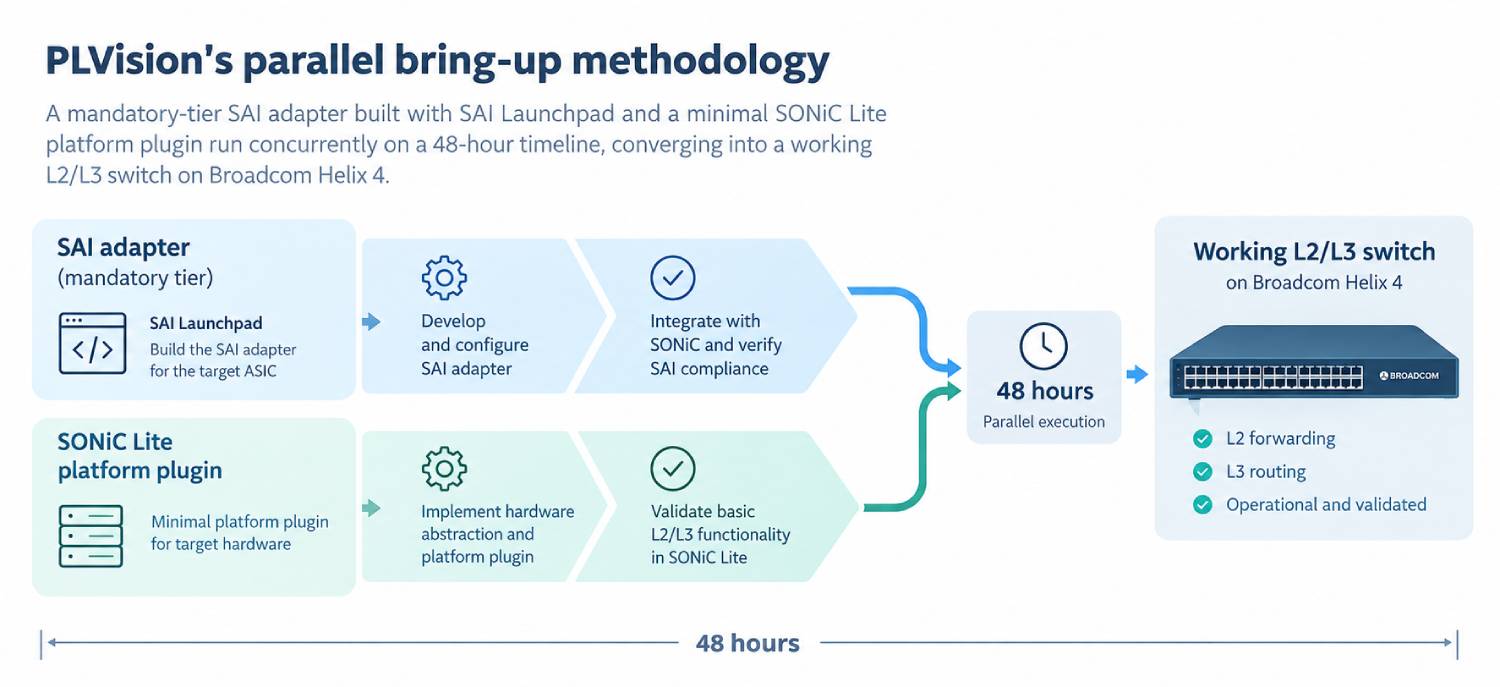
Figure 1: PLVision’s parallel bring-up methodology
Why SAI Launchpad Matters Before You Write a Line of Code
Before jumping into the first SAI milestone, it’s worth explaining what SAI Launchpad gave the team at hour zero – because this is the difference between starting from a blank editor and starting from a proven accelerator.
SAI Launchpad is PLVision’s software foundation for SAI adapter development: a reusable starting point with implementation structure, metadata handling, integration patterns, and validation assets that help engineering teams turn an ASIC SDK into a SONiC-ready SAI layer. Around that foundation, PLVision engineers production-grade SAI implementation, integration, and validation for ASIC vendors and solution builders. In this hackathon, SAI Launchpad gave the team a practical base for translating Broadcom Helix 4 SDK capabilities exposed through OpenBCM into the SAI semantics that SONiC Lite expects.
As a result, the team ran the SAI work the way it would run a production adapter program: in planned stages, each one validated before the next.
- The SDK-to-SAI mapping was explicit from the start. OpenBCM remained the SDK layer for programming Helix 4, while the SAI adapter exposed those capabilities through the vendor-neutral SAI object model expected by SONiC Lite.
- Mandatory-tier support came first. Instead of trying to cover every object type and attribute the SAI specification defines at once, the team implemented the switch, port, VLAN, host interface, and routing primitives needed for SONiC Lite to initialize, bring ports up, and start forwarding traffic.
- Validation followed the code. Each new piece of the SAI adapter was smoke-tested as soon as it was written, against SONiC Lite as the integration target, so every test moved the team closer to a stable SONiC integration.
- The outcome was SONiC readiness, which goes further than first packet. The goal was to make Helix 4 visible to SONiC Lite through the standard SAI path, so higher-level SONiC components could configure features without being rewritten for the Broadcom SDK.
Put simply: when the hackathon clock started, the team already had a structured starting point. Its job was to make the OpenBCM SDK behave the way SONiC’s SAI interface expects, in four steps: map what the SDK can do, implement the mandatory SAI objects first, validate each step, then switch on the higher-level L2/L3 features through the normal SONiC pipeline.
Hour 0–16: A Minimal SAI on OpenBCM
The data-plane team started by mapping Broadcom Helix 4 capabilities exposed through OpenBCM into the SAI object model that SONiC Lite expects. OpenBCM served as the ASIC SDK layer; SAI Launchpad shaped the adapter work above it. The strategy was strictly mandatory-tier first: implement the object types and mandatory attributes SONiC needs to initialize – switch, ports, VLANs, host interfaces, and the initial routing path – and defer optional coverage until the base system was stable.
The milestone everyone was waiting for wasn’t glamorous: syncd starting cleanly, initializing the ASIC, and holding a stable switch object without crashing on a missing attribute. Once that was held, ports came up under SONiC’s control, and the abstraction pipeline – CONFIG_DB → APPL_DB → ASIC_DB → syncd → libsai – was live end to end for the first time.
That sequencing kept the SAI story aligned with production development practice: SDK behavior was translated into SAI objects, mandatory coverage was validated first, SONiC Lite was used as the real integration target, and feature work only advanced once the control path was stable. The hackathon compressed the timeline, but it did not change the engineering model.
Hour 12–20: Platform Comes Alive
The platform work moved fast – it was the shorter of the two streams. Working against the SONiC platform API, the team skipped anything speculative and targeted the four things an operator looks at first:
- Fans – presence, status, speed, and duty-cycle control
- PSUs – presence and status
- SFP/optics – presence and EEPROM read
- Sensors – temperature and voltage telemetry
In SONiC, this hardware access runs through the Platform Abstraction Layer (PAL): a set of Python base classes that define one standard API. SONiC’s platform monitoring daemons (PMON) and CLI tools call that API, and each device maker implements it for its own board. That implementation is called a SONiC platform plugin.
SONiC Lite keeps upstream SONiC’s PAL contract unchanged, so the Helix 4 plugin had the same structure as a plugin for any Community SONiC switch, and an engineer who has written one before can write this one with no proprietary re-learning.
Once the show platform command returned real fan speeds (RPM) and PSU status in place of placeholder values, the board started behaving like a switch you could deploy. The platform stream also stayed inside its share of memory, leaving the data-plane stream the room it needed.
This is where the containerless SONiC Lite architecture pays off: on a 2 GB board, every megabyte the operating system leaves unused stays available to the platform daemons, syncd, and orchagent.
Hour 20–48: From Ports to BGP
With a stable SAI and a live platform, the last stretch was feature enablement – and this is where SONiC’s architecture pays back the investment. The control plane already reached the chip through SAI, so switching on each feature came down to two things: adapter support for the SAI objects that feature uses, and configuration. Very little feature-specific code was needed:
- Port configuration – speeds and admin state programmed through SAI
- VLANs and SVIs – Layer 2 segmentation plus switched virtual interfaces for inter-VLAN routing
- FDB – MAC learning and forwarding in hardware
- LAG – link aggregation across physical members
- BGP – brought up through FRRouting, exchanging routes and installing them into the ASIC via the same SAI path
By the 48-hour mark, the Helix 4 board booted SONiC Lite, monitored its own hardware, and forwarded traffic across VLANs and LAGs against a BGP-learned route – a coherent L2/L3 switch, with every piece working together, all inside 2 GB of RAM.
That coherence is what the abstraction is for. SAI is the layer that turns what the chip’s SDK can do into the standard operations SONiC calls. How complete and stable that layer is decides whether you have a working demo or a platform customers can deploy with confidence.
Two days of hackathon work produce the demo. Deployment confidence comes later, with validation and hardening. What the two days prove is that the path to first packet is short when the tooling and the base OS are the right ones.
What the Weekend Actually Proved
Nobody is shipping a hackathon build. Validation, corner cases, hardening, and the long tail of optional SAI attributes are exactly the work that separates a weekend prototype from a production distribution – and that work is the real job. But the exercise made four things concrete:
- The abstraction model works as advertised. A minimal SAI adapter plus a minimal platform plugin is enough to get a new chip running under SONiC. Adding new silicon touches far less of the NOS than it seems to.
- Reusable tooling turns “months” into “hours” for first packet. SAI Launchpad gave the team, from hour zero, the skeleton code, metadata wiring, and test scaffolding that would otherwise take weeks to write. It gives a production program the same head start, removing the usual bottlenecks of feature mapping, SDK behavior, and SONiC integration constraints.
- Staged, parallel bring-up beats sequential integration. Mandatory-tier SAI first, platform in parallel, features last: the same method PLVision uses to de-risk customer programs, compressed cleanly into 48 hours.
SONiC Lite gets cost- and memory-constrained silicon running fast. An integrated CPU+ASIC part like Helix 4, with only 2 GB of RAM, is exactly the type of platform SONiC Lite is built for – cost-effective access and management use cases where traditional SONiC would be too heavy.
Work with the SONiC Experts
Benefit from PLVision's deep experience delivering enterprise SONiC solutions across industries.
From 48 Hours to Production
The hackathon compresses the “first packet” question. The real customer question – the one that turns a hackathon prototype into a shipping product – is what comes after, and that’s where SAI Launchpad matters as both a software foundation and an engineering accelerator. In a production SAI Launchpad program, PLVision builds on that foundation to reach four outcomes:
- A working SAI adapter for the target ASIC, integrated and validated
- A successful SONiC bring-up on the target platform
- Prioritized baseline features implemented and stabilized, with clear regression visibility throughout the process
- A structured handover so the internal team can carry the work forward with confidence
SONiC Lite plays the same role on the operating-system side that SAI Launchpad plays on the adapter side. For OEMs and ODMs that need the NOS ready for cost-effective platforms too, SONiC Lite is an enterprise distribution of SONiC by PLVision for cost-effective management and access platforms in data center, edge, and campus deployments, with SAI and platform integrations preserved and the container/lifecycle overhead removed.
If you’re evaluating a new ASIC or an integrated switch SoC and wondering how quickly it can meet SONiC, the honest answer from this hackathon is: first packet comes faster than you’d expect when the work starts from a proven foundation. PLVision’s engineers never start from a blank editor, and neither should you. Everything after first packet is what they do for a living.
Curious what a production-grade bring-up looks like on your silicon? Let's talk.

- 48 Hours to First Packet: Porting SONiC Lite to Broadcom Helix 4 at a PLVision Hackathon - September 25, 2026
- Why PNAC is a Crucial Feature for PLVision’s SONiC Lite - February 7, 2025
- Setup Instructions for SONiC Lite Demo - January 28, 2025